
Mortars,
Cement-Based Waterproofing Materials
At Colcret, a brand of the Pavicret Group, we develop and manufacture a range of cement-based waterproofing mortars to protect surfaces from water and moisture. We offer rigid, semi-flexible, and flexible solutions for waterproofing terraces, balconies, swimming pools, storage tanks, basements, and other structures—whether in new construction or renovation projects—tailored to the specific conditions of each application.
You can contact us and request your shipment to any part of Spain, or visit us at any of our locations throughout the country.
Come to any of our locations, we will show you why our product is the one you are looking for .
We have a technical team that will give you the best solutions adapted to your work. Easily contact our technicians at any time.
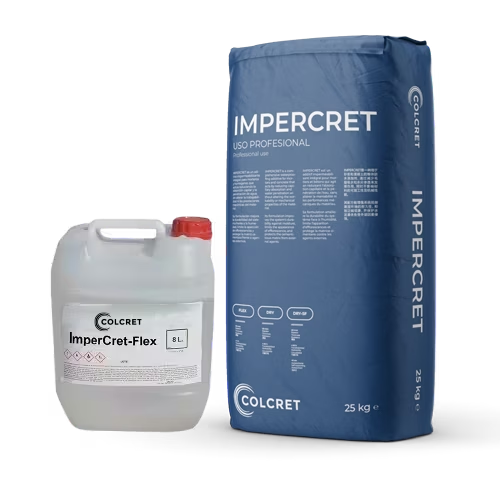
A flexible, two-component cementitious waterproofing mortar designed to protect surfaces exposed to water and minor movements of the substrate. Especially suitable for patios, balconies, swimming pools, and applications under ceramic tile coverings when crack-bridging capability is required.
A single-component, semi-flexible cementitious waterproofing mortar formulated to protect mineral surfaces from water and accommodate minor deformations in the substrate. A solution for interior and exterior waterproofing projects where greater flexibility than that of a rigid system is required.
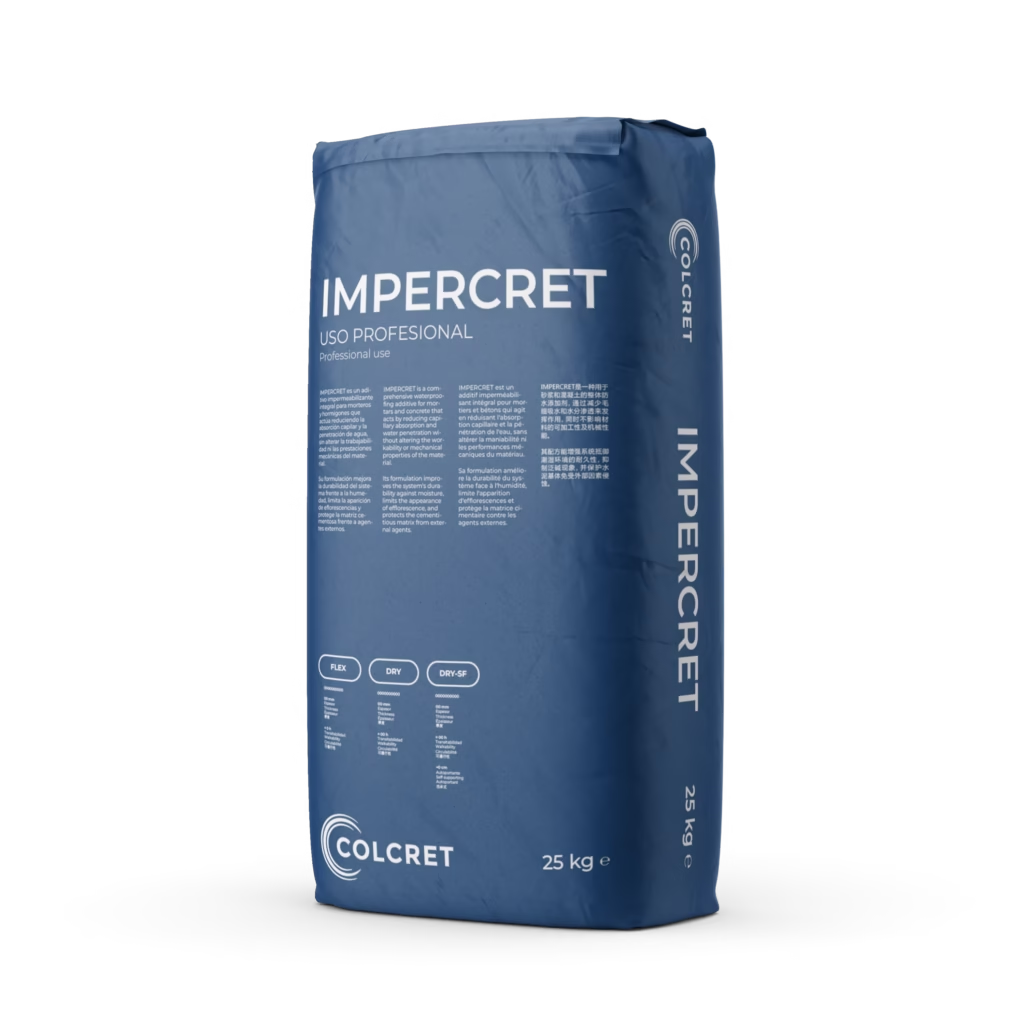
A single-component, semi-flexible cementitious waterproofing mortar formulated to protect mineral surfaces from water and accommodate minor deformations in the substrate. A solution for interior and exterior waterproofing projects where greater flexibility is required than that provided by a rigid system.
Frequently Asked Questions About Waterproofing Products

What are the differences between Impercret Dry, Impercret Dry SF, and Impercret Flex?
The choice of system depends on the type of support and the loads:
Impercret Dry is a rigid waterproofing mortar, suitable for stable substrates with no risk of cracking.
Impercret Dry SF is a semi-flexible mortar capable of absorbing minor deformations and withstanding more severe water pressure.
Impercret Flex is a flexible two-component system, particularly recommended for use where microcracks are present, the substrate is subject to movement, or the product is applied under ceramic tiles.
Each system is designed to meet a different level of mechanical stress and deformability.
Can Impercret systems be used in areas with water pressure?
Yes.
Impercret systems are designed to operate under positive hydrostatic pressures, and in some cases, negative pressures as well:
Impercret Dry withstands both positive and negative pressures, although it is recommended to apply it on the positive side.
Impercret Dry SF and Impercret Flex can withstand high water pressures (up to 7.5 atm), making them suitable for tanks, swimming pools, basements, and elevator shafts.
Choosing the right system is key to preventing detachment under negative pressure conditions.
What kind of surface preparation is needed before waterproofing?
The stand must be:
Sound, sturdy, and clean, free of dust, oil, paint, or loose parts.
Moisten to saturation, avoiding standing water, especially on cementitious products.
On smooth or low-absorbency substrates, ensure the proper surface texture is achieved using mechanical methods.
Improper preparation can compromise the adhesion and watertightness of the waterproofing system.
How many coats and what thickness should be applied to ensure waterproofing?
In general:
Impercret systems are applied in at least two cross-coated layers.
The recommended total thickness is usually between 2 and 5 mm, increasing in situations where water pressure is high.
With Impercret Flex, it is recommended to apply 3 to 4 coats to ensure continuity, elasticity, and the ability to bridge cracks.
Adhering to the recommended number of coats and thicknesses is essential for achieving long-lasting waterproofing.
When can an Impercret waterproofing system be loaded or put into service?
The times depend on the system and environmental conditions:
The waterproofing must cure properly, avoiding rapid drying.
Light physical activity is usually permitted after 3–7 days.
Water pressure testing typically takes between 7 and 14 days, especially in reservoirs or swimming pools.
Adhering to these timeframes is key to ensuring the system’s watertightness and durability.