
Self-Leveling Mortars
for Floors
At Colcret, a brand of the Pavicret Group, we develop and manufacture a line of self-leveling floor mortars designed to level surfaces and correct unevenness before installing floor coverings. Our Pavilevel line offers solutions with different application thicknesses, mechanical strengths, and drying times, tailored to the needs of new construction and renovation projects.
Shipping to all Spain
You can contact us and request your shipment to any part of Spain, or visit us at any of our locations throughout the country.
We show you the product
Come to any of our locations, we will show you why our product is the one you are looking for .
Technical team
We have a technical team that will give you the best solutions adapted to your work. Easily contact our technicians at any time.
Self-leveling mortar designed for interior floors for residential and light commercial use. Its fluid consistency is easily distributed with a screed or pump and levels itself, correcting imperfections of 5 to 10 mm. mm to 50 mm thick. It provides a mechanical resistance suitable to receive ceramic tiles, parquet or carpet after 24 hours. h drying time. Compatible with radiant heating.
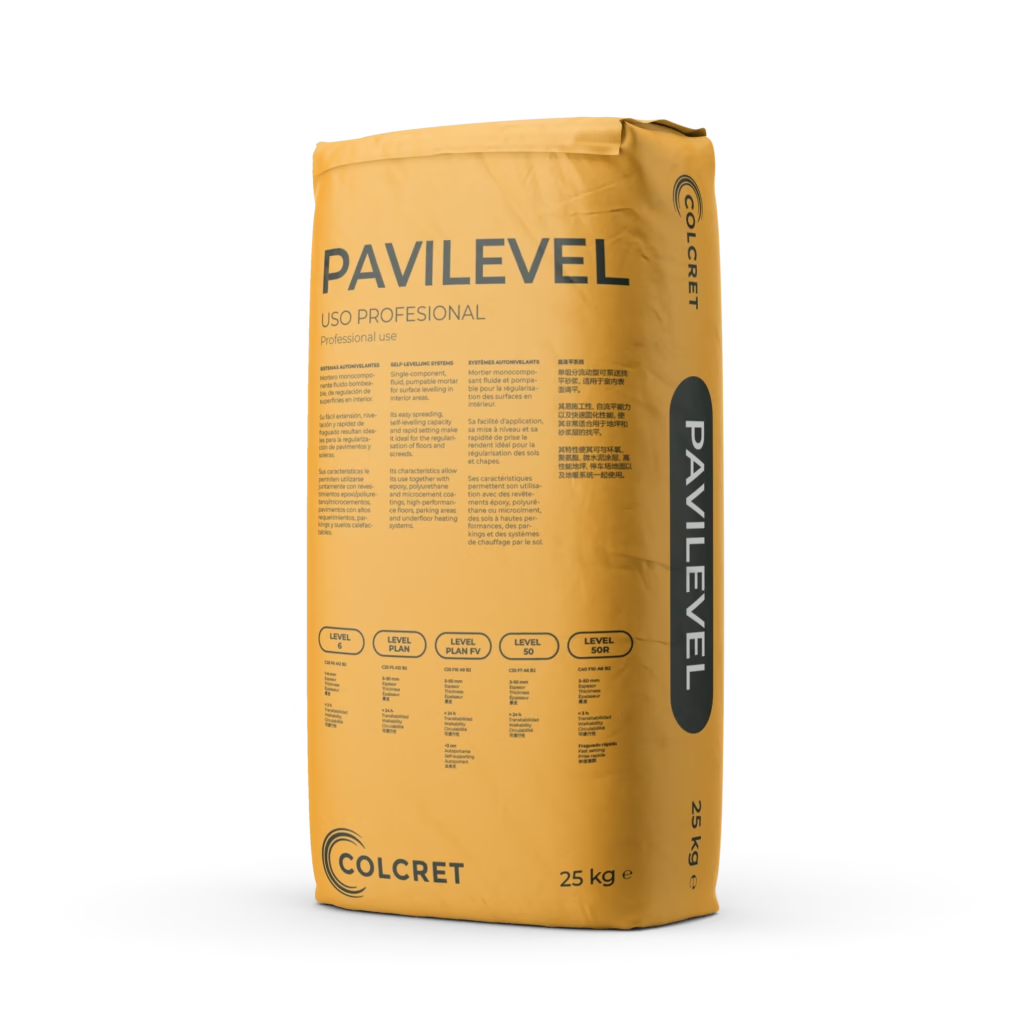
Formulated with setting-accelerating additives, it allows for light traffic in as little as 12 h and place the final coating the same day (always consult the technical data sheet according to ambient temperature). Recommended for renovation of commercial premises, hotels or occupied homes where every hour counts. Thicknesses of 5 mm to 15mm.
When the project requires a perfectly flat floor for PVC, linoleum or continuous pavements, Pavilevel50Plan is the right reference. Its fine granulometry and high thixotropy achieve a silky finish from only 1 mm thick. Ready for light traffic at 12 o’clock h and to receive flexible coatings at 24h.
Incorporates glass microfibers that increase tensile strength and minimize the risk of cracking in layers of 10mm to 30mm. Ideal for industrial buildings, garages or floors subjected to point loads. Suitable for pumping over long distances and compatible with radiant heating.
Frequently Asked Questions About Self-Leveling Compounds
For what types of projects are Pavilevel self-leveling systems recommended?
Pavilevel systems are designed to level and smooth interior floors before installing floor coverings. They correct irregularities and create flat, smooth surfaces suitable for ceramic tile, natural stone, hardwood flooring, vinyl, carpet, and continuous synthetic flooring. They are suitable for both new construction and renovation projects and are compatible with radiant heating systems.
What are the differences between Pavilevel 50 and Pavilevel 50 R?
Both are polymer-based self-leveling mortars for interior use, with thicknesses ranging from 5 to 50 mm, but:
- Pavilevel 50 is designed for standard applications involving 24-hour pedestrian traffic.
- Pavilevel 50 R is fast-drying, allowing pedestrian traffic after 12 hours, which makes it ideal when shorter construction schedules or rapid commissioning are required.
What application thickness do Pavilevel systems support?
The thickness depends on the product:
Pavilevel 50 / 50 R: 5 to 50 mm.
Pavilevel Plan: 5 to 15 mm.
Pavilevel Plan FV (fibrillated): 5 to 30 mm, with improved shrinkage control and greater flexural strength thanks to AR glass fibers.
Adhering to the recommended thicknesses is key to ensuring the flatness and final performance of the system.
Is it necessary to prepare or prime the substrate before applying a self-leveling compound?
Yes. Surface preparation is essential:
The substrate must be sound, strong, clean, and have a residual moisture content of less than 3%.
On absorbent substrates, it is recommended to apply a primer with bonding resins.
On substrates with little or no absorbency, specific primers or epoxy systems with aggregate are used.
Improper surface preparation can affect the adhesion, flow, and final performance of the self-leveling compound.
What are the most common mistakes when applying a self-leveling compound?
Some common mistakes to avoid are:
Adding more water than recommended, causing segregation and a loss of strength.
Failure to respect structural, perimeter, or partition joints.
Use the product outside the recommended temperature range (5–35 °C).
Do not pour the concrete continuously, as this can cause streaks or unevenness.
Avoiding these mistakes ensures a uniform, durable surface that is ready for the final finish.